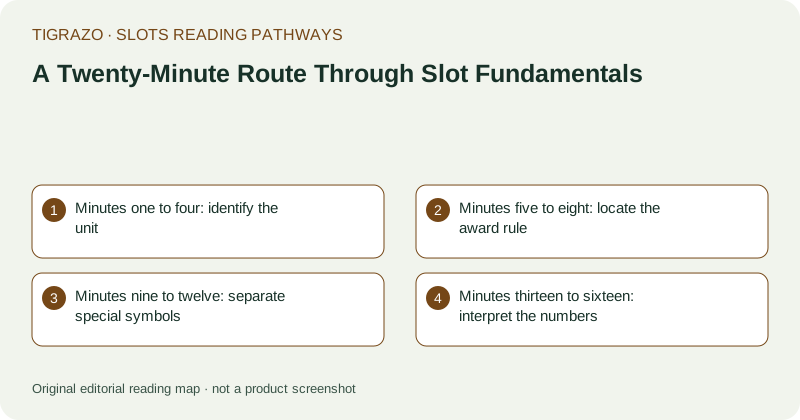
Minutes one to four: identify the unit
Begin with the total stake for one paid round. A coin value, line amount or credit denomination may be only one component of that cost. Read the control labels together with the rules until you can state the stake in currency without guessing. Note whether an optional setting changes the amount.
Your first checkpoint is deliberately simple: could you explain what pressing the main start control would cost? If the answer is unclear, remain at this stop. Decorative symbols and animated features do not resolve an ambiguous price.
Minutes five to eight: locate the award rule
Next, identify how matching symbols qualify. A payline may require consecutive reels in a specified direction; a ways game may count matching symbols across adjacent reels; a cluster game may use connected positions. These are different rule systems, not interchangeable names for matching pictures.
Find one example in the paytable and describe it in plain English. Include the required count, position or direction, and any special-symbol exception. This creates a stronger foundation than memorising every displayed prize.
Minutes nine to twelve: separate special symbols
Read the roles of wild, scatter and trigger symbols separately. A wild need not replace every other symbol. A scatter may pay independently of lines, trigger a feature, do both, or another version may define it differently. Treat the actual rule text as the authority.
Write one sentence for each role. If two symbols look similar but behave differently, record that distinction now. Visual resemblance is not evidence that their functions match.
Minutes thirteen to sixteen: interpret the numbers
Read RTP as a long-run expected return over total wager volume. It does not describe a promise for your next twenty minutes. Volatility concerns variation in results, while hit frequency counts qualifying winning outcomes under a particular definition. None of these measures makes an independent next spin due.
Hypothetical example: twenty rounds at a total stake of 0.50 each create 10.00 of wager volume. That calculation describes spending exposure, not the amount you will lose or recover.
Minutes seventeen to twenty: close the route
Finish by identifying a spending boundary, a time boundary and a way to stop without starting another round. Reading can end here even if every rule is understood. Knowledge is useful without any subsequent transaction.
- Can you name the total cost?
- Can you explain one valid winning pattern?
- Can you separate expectation from prediction?
- Do you know which unanswered question needs a longer reading route?
Keep those answers as a short reference. A complete set of notes is a better outcome than a hurried attempt to cover every feature.