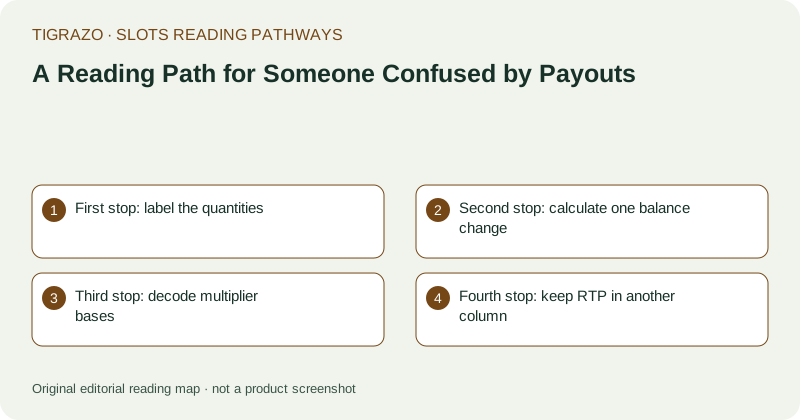
First stop: label the quantities
Write four headings: stake, award, balance before and balance after. The stake is the amount charged for the round. The award is the amount credited by its result. The balance change combines both movements. A displayed win therefore need not mean that the round produced a positive net result.
Check whether the interface uses currency or credits. If credits are shown, find the conversion before attempting any comparison. The same number can represent very different amounts under different denominations.
Second stop: calculate one balance change
Hypothetical example: a balance starts at 20.00, a round costs 1.00 and its award is 0.40. The ending balance is 19.40. The displayed award is real within the example, but the net result is a loss of 0.60. Calling the outcome a win does not change that arithmetic.
Now change the award to 3.00 while keeping the other figures unchanged. The ending balance becomes 22.00, and the net gain is 2.00. Keep gross award and net gain in separate columns in your notes.
Third stop: decode multiplier bases
A multiplier requires a base. It might multiply the total stake, a line stake, a symbol award or an accumulated feature amount. Read the sentence immediately around the number rather than treating the multiplication sign as a complete explanation.
Hypothetical example: 20 times a 0.05 line stake is 1.00, whereas 20 times a 1.00 total stake is 20.00. The identical multiplier produces different currency awards because the underlying unit differs.
Fourth stop: keep RTP in another column
RTP belongs to long-run expectation over wager volume, not to the settlement calculation for one round. A stated percentage cannot tell you which award should appear next. It also does not correct a misunderstanding about credits, multipliers or the stake used by the paytable.
If an article moves directly from a return percentage to a claim about your likely short session balance, pause. The missing bridge is the distribution of possible outcomes, and even that distribution would not promise a particular session result.
Final checkpoint: explain without promotional language
Choose a sample award and explain it using only units and rules. State the stake charged, the basis of any multiplier, the gross award and the resulting net change. Avoid words such as generous or rewarding while checking the calculation.
- Are all amounts expressed in the same unit?
- Does the award include or exclude any returned stake?
- Are separate rounds being accidentally combined?
If these questions remain unresolved, return to the paytable or recorded round details rather than inferring the answer from a celebratory animation.