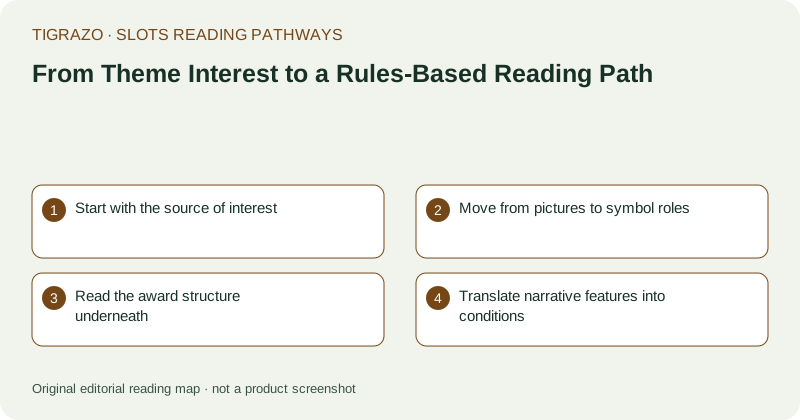
Start with the source of interest
Name what caught your attention: an illustrated landscape, a historical motif, comic characters or an unusual soundscape. This is a valid editorial starting point. It becomes misleading only when aesthetic appeal is treated as evidence of favourable payouts, frequent features or lower financial risk.
Write a short description using visual terms alone. For example, layered backgrounds and contrasting symbol shapes describe presentation. Words such as profitable or forgiving introduce claims that the artwork cannot establish.
Move from pictures to symbol roles
Locate the symbol key and map each important image to its function. A character portrait may be an ordinary paying symbol rather than a special trigger. A dramatic emblem may be decorative. The theme's apparent hierarchy need not match the paytable's award hierarchy.
Checkpoint: can you identify a wild, a scatter and a regular symbol from the rules rather than from visual prominence? If a role does not exist in the version being read, leave it absent from your notes instead of inventing an equivalent.
Read the award structure underneath
Next, establish whether awards use lines, ways, clusters or another specified system. Record direction, minimum match and any exclusions. A theme might suggest collecting objects, yet the actual qualification could still depend on consecutive matching reels.
Hypothetical example: three compass symbols on reels one, two and three qualify under a stated left-to-right rule. The same symbols on reels one, three and five would not qualify under that rule. The adventure motif does not override the missing consecutive reels.
Translate narrative features into conditions
A feature described as opening a vault or beginning a journey still needs an entry condition and a settlement rule. Read how it starts, what changes during it and when it ends. Distinguish narrative progress from any mechanically persistent state.
A map that fills with colour may represent completed steps, an optional collection or a decorative animation. Unless the rules establish a relationship to probabilities or awards, the visual journey does not establish one on its own.
Finish with two independent summaries
Write one sentence about the presentation and one about the mechanics. A useful pair might say that the artwork uses maritime imagery while the rules award consecutive matches on specified paylines. Keeping the sentences separate prevents one assessment from borrowing authority from the other.
- Which impressions come from art?
- Which statements are verified by rules?
- Which mathematical details remain unknown?
- Would the rules summary remain accurate with different artwork?
The route is complete when you can appreciate the theme without asking it to answer questions about expected return, variance or the suitability of spending money.