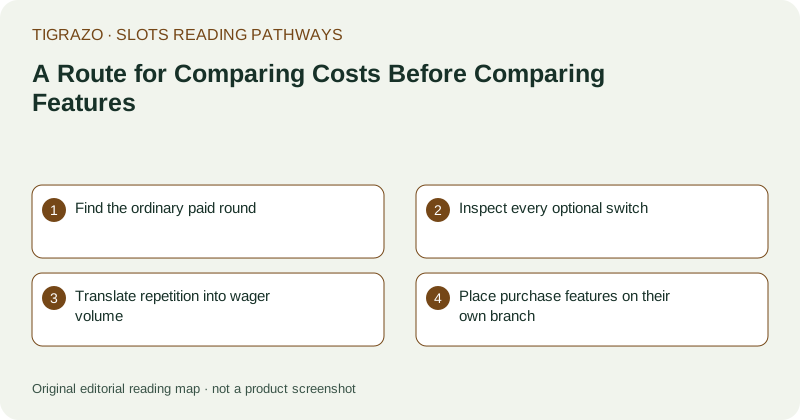
Find the ordinary paid round
Begin at the stake display and confirm what it represents. Some interfaces show a complete round amount; others also show component values such as denomination or line stake. Do not add or multiply controls unless the rules explain their relationship.
Record a single currency amount for the configuration under discussion. If that cannot be established, cost comparison stops here. A prominent minimum value is not necessarily the price of every selectable configuration.
Inspect every optional switch
Read settings that mention enhanced chances, extra features or alternative modes. Determine whether they increase the round stake, create a separate purchase or alter eligibility. A switch that appears visually modest can change the quantity being compared.
Make two rows if necessary: standard configuration and optional configuration. Keep their features attached to the appropriate row. Combining the cheapest price from one setting with the feature description of another creates a comparison that describes neither.
Translate repetition into wager volume
Hypothetical example: forty rounds at 0.25 create 10.00 of wager volume. Forty rounds at 0.40 create 16.00. The difference is 6.00 in total amounts staked, regardless of what either sequence returns.
These are exposure calculations, not forecasts of losses. Awards may be credited during play, but using those credits for later rounds still adds wager volume. A balance funded once can support more total wagering than the initial deposit amount.
Place purchase features on their own branch
A feature purchase is not simply another ordinary round at the displayed base stake. Read the actual purchase amount, the stake basis and the entry conditions. Determine whether the purchased feature differs from a naturally triggered version before comparing their possible awards.
Checkpoint: can you describe the immediate maximum amount committed by the next action? If the answer depends on an unread confirmation screen or a changing setting, mark the comparison incomplete rather than inserting an estimate.
Compare features only after cost is legible
Now create a small matrix containing total round stake, optional charge, purchase amount if applicable, and conditions altered by each setting. Add feature descriptions only after those cost fields are clear. More features do not inherently represent better value.
Keep personal limits outside the ranking exercise. An accurately described cost can still be beyond an acceptable spending boundary. A comparison should permit the conclusion that neither option needs to be used.
- Are amounts in the same currency?
- Are stake bases equivalent?
- Have optional charges been separated?
- Does the comparison distinguish wager volume from net loss?
Save unresolved fields as questions for further reading. A blank cell with a clear reason is more useful than a confident figure built from mismatched units.