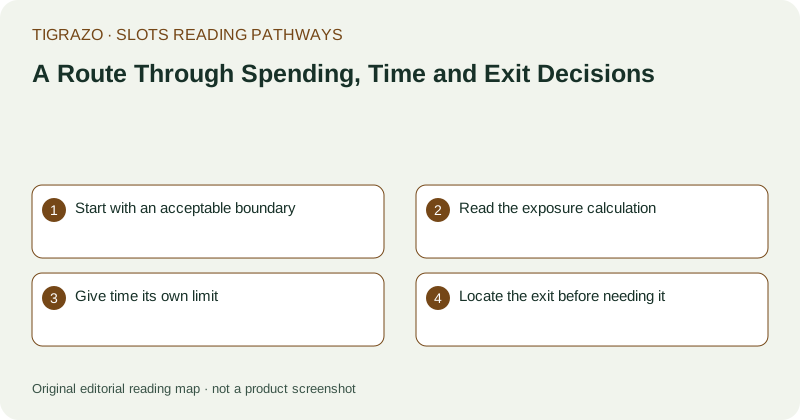
Start with an acceptable boundary
Decide what amount, if any, can be treated as discretionary spending without affecting essentials or obligations. This decision belongs outside the game's feature descriptions. A compelling theme or a high maximum award does not change the resources available.
Separate a spending boundary from a prediction of loss. You cannot use RTP to know a session's ending balance, and a small starting amount can generate substantial wager volume if awards are repeatedly staked again.
Read the exposure calculation
Identify the total stake and consider how repeated rounds accumulate. Hypothetical example: sixty rounds at 0.20 represent 12.00 of wager volume. At 0.50, the same count represents 30.00. Neither figure states the eventual net loss, but both make the scale of repeated commitments legible.
Checkpoint: does changing a stake or optional setting invalidate the original calculation? If so, update the amount before continuing. A plan based on one configuration should not silently follow another.
Give time its own limit
Choose a finishing time or elapsed-time boundary independently of spending. A session can remain within a money limit while using more attention than intended. Conversely, a short session can still exceed a spending boundary if stakes are high.
Allow for the difference between initiating a new round and waiting for an existing round to settle. The plan should identify when to stop starting further activity, while preserving access to the record of any unresolved round.
Locate the exit before needing it
Identify how to stop optional automation, close the game and inspect account or round history. Read relevant control labels rather than assuming that closing a window cancels an already accepted round. For settlement uncertainty, rely on the recorded result and the appropriate support route.
A visual progress meter is not an instruction to remain. Unless rules establish otherwise, apparent nearness to a feature does not show that an independent trigger is due. An unfinished animation theme should not rewrite a previously chosen boundary.
Combine the decisions into a short note
Use three statements: the spending boundary, the time boundary and the action that ends further play. Add a fourth if you need a route for unresolved settlement questions. Keep the wording factual and usable without calculations under pressure.
- Does the note allow stopping after a win?
- Does it allow stopping after a loss?
- Does it avoid a recovery target?
- Can you choose not to begin at all?
The route succeeds when exit remains available regardless of the most recent outcome. Limits are boundaries, not challenges to reach or amounts that must be spent.