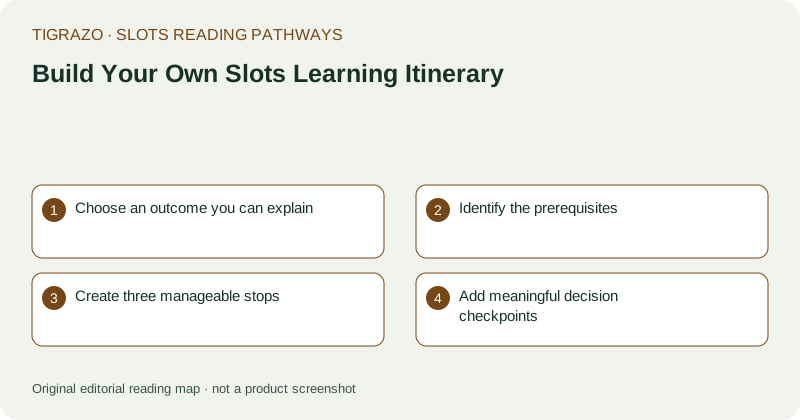
Choose an outcome you can explain
Replace broad goals such as understand slots with a specific explanation you want to produce. Examples include explaining a line-stake multiplier, distinguishing scatter pay from feature entry, or comparing fixed and progressive prize structures. A narrow outcome makes both progress and completion visible.
Write the goal as a sentence beginning with explain or distinguish. Avoid goals based on finding a profitable method, because reading cannot turn independent random outcomes into a predictable sequence.
Identify the prerequisites
List concepts the chosen question depends on. Understanding a payout multiplier requires knowing its base. Comparing feature purchases requires understanding total cost and eligibility. Reading a cascade requires understanding how the initial award qualifies before symbols are removed.
Put prerequisite questions first. If a later explanation contains an unfamiliar term, add that term to the earlier part of the route rather than pretending its meaning is obvious. This small adjustment prevents uncertainty from accumulating.
Create three manageable stops
Use a foundation stop, an application stop and a verification stop. The foundation establishes definitions. The application follows one concrete example. The verification checks that you can explain the relationship without relying on a screenshot or a memorable animation.
Hypothetical itinerary: first identify a 0.10 line stake, then calculate a 15-times line award as 1.50, then explain why the same multiplier cannot automatically be applied to a 2.00 total stake. The sequence teaches the dependency rather than just the answer.
Add meaningful decision checkpoints
At each stop, ask a question that can change the route. If the rule version is unknown, branch to version identification. If the arithmetic is clear but the qualification pattern is not, return to the award rule. Do not add another general article simply to make the itinerary longer.
Mark sources of uncertainty as missing information, ambiguous wording or an unfamiliar concept. These require different responses. More repetition may help with an unfamiliar term but cannot supply an unpublished configuration detail.
Decide how the route ends
A good endpoint is a short explanation, a completed comparison row or a clearly documented unresolved question. None requires placing a wager. Keep a small record so a future visit can begin at the remaining question rather than restarting every topic.
- What will I be able to explain?
- Which concept must come first?
- What example checks my understanding?
- What would make me pause or change direction?
- What counts as enough?
Review the itinerary after using it. Remove redundant stops and retain useful checkpoints. The aim is not an exhaustive curriculum but a dependable way to move from curiosity to a bounded, accurate understanding.