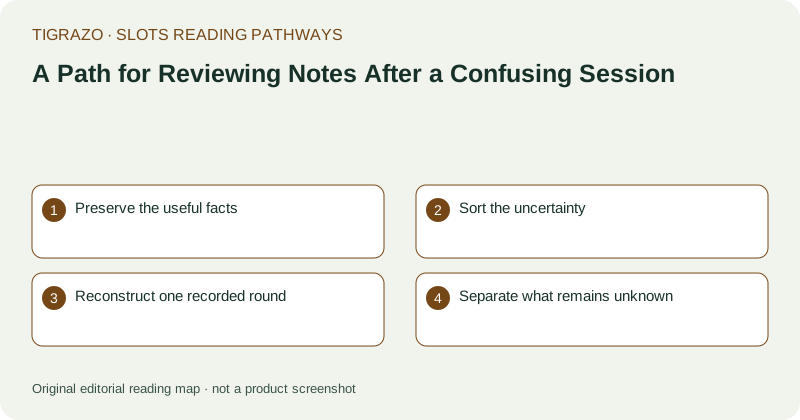
Preserve the useful facts
Record the approximate time, game version if known, selected stake and the nature of the confusion. Keep any relevant round identifier and transaction details in a private note. Describe what appeared rather than why you think it happened.
For example, write that a displayed running total changed after an animation rather than asserting that an award disappeared. The first statement is an observation; the second is an interpretation that needs settlement evidence.
Sort the uncertainty
Create three headings: interface, rule and settlement. Interface questions concern what a screen element represents. Rule questions concern how an award qualifies. Settlement questions concern what was charged or credited. One incident can involve all three, but each needs a different kind of explanation.
Checkpoint: can you put the main question under one heading? If not, split it into smaller questions. This prevents a visual misunderstanding from being treated automatically as a financial discrepancy.
Reconstruct one recorded round
Use the available round history rather than attempting to repeat the outcome. Identify the stake, credited award and resulting balance movement. Check whether a feature total already includes intermediate amounts and whether the record groups several actions into one settlement.
Hypothetical example: a starting balance of 15.00, a stake of 0.50 and a credited award of 1.20 produce 15.70. If the display showed the 1.20 in three instalments, adding those instalments to the final total again would double-count the same award.
Separate what remains unknown
Mark each statement as recorded, inferred or unresolved. Recorded information comes from the relevant history or rule. Inferences are interpretations consistent with it. Unresolved items lack enough information. These labels keep an early guess from becoming an apparent fact through repetition.
If a technical issue remains, preserve the round identifier and concise description for the appropriate support route. Avoid repeated reloads, new deposits or further rounds as a diagnostic loop. Those actions create additional events without necessarily clarifying the original one.
Finish with a bounded follow-up
Choose the next step that matches the question: reread one rule, inspect one history entry or request clarification about one recorded event. State what answer would resolve the issue. There is no requirement to settle every uncertainty in a single sitting.
- Have observation and interpretation been separated?
- Are the amounts expressed in one unit?
- Could a cumulative total have been counted twice?
- Is the next step informational rather than another wager?
Close the review when the evidence has been organised. A pause protects the quality of the record as well as your time and spending boundaries.