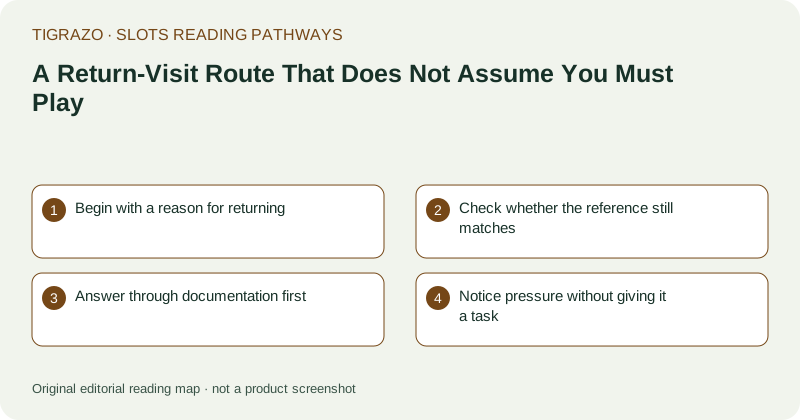
Begin with a reason for returning
Choose one question from your previous notes. It might concern symbol substitution, a multiplier base or the cost of an optional mode. Avoid beginning with an open-ended intention to see what happens, because that provides no natural finishing point for a reading visit.
Write the question before opening additional material. A narrow purpose makes it easier to recognise completion. If no question remains important, the route can end immediately without any need to manufacture a task.
Check whether the reference still matches
Look for version identifiers, stake configuration and the source of the displayed rules. A familiar title or illustration does not establish that every setting is unchanged. Compare the exact condition relevant to your question rather than rereading the entire feature catalogue.
Checkpoint: are your earlier notes about this version and this configuration? If that cannot be confirmed, preserve the old note as historical context and start a separate current entry. Do not silently merge potentially different rule sets.
Answer through documentation first
Read the paytable, help text or recorded round details appropriate to the question. A symbol rule should be established through the symbol explanation; a settlement question may require a round record. Random outcomes are a poor substitute for missing documentation.
For a hypothetical multiplier question, suppose the rule states that a 5-times modifier applies to a 2.00 award. The resulting amount is 10.00. Once that relationship is clear, there is no need to reproduce the outcome through additional rounds.
Notice pressure without giving it a task
A return visit may expose bright counters, large award displays or unfinished-looking meters. Treat these as interface elements to interpret, not instructions to continue. A persistent state matters only in the way the rules establish; visual incompleteness does not create an obligation.
If the visit begins drifting beyond its original question, use that as a checkpoint. You can close the page, save an unresolved note or return another day. None of these actions invalidates the work already done.
Close with a useful record
Write the answer, the configuration it applies to and any remaining uncertainty. A short entry is enough if it resolves the original issue. Remove or clearly supersede an earlier mistaken interpretation so it cannot be reused accidentally.
- Was the original question answered?
- Did any relevant rule change?
- Is a remaining uncertainty worth further reading?
- Can the visit end now?
The successful endpoint is clarity, including clarity that nothing further needs attention. Reading-only visits are complete visits, not incomplete versions of a gambling session.