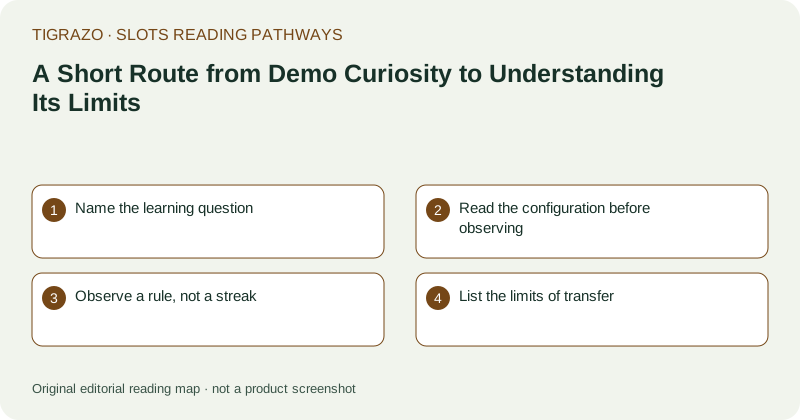
Name the learning question
Start with a mechanical question: where is the paytable, how does a cluster connect, or when does a running total update? These questions are suited to observation because their answers concern presentation and stated rules rather than future profitability.
Avoid framing the exercise as finding out whether a game pays well. A short sequence cannot establish its theoretical distribution, and a demo's conditions may differ from those of another available version.
Read the configuration before observing
Check the stake unit, rule version and any information about the demonstration environment. A large fictional balance may make costs feel insignificant even when the same numerical stake would be meaningful in currency. A reset button can also remove a consequence that would exist outside the demonstration.
Checkpoint: which conditions are documented as equivalent, and which are merely assumed? Keep an explicit unknown entry for anything the demo does not establish. Shared artwork is not sufficient evidence of identical mathematics or settings.
Observe a rule, not a streak
Use the demonstration to follow the sequence around a known event. Watch which symbols qualify, how an animation indicates a line or cluster, and whether the displayed total is cumulative. Compare each observation with the paytable.
Hypothetical example: a 3-times modifier applied to a displayed 4-credit award produces 12 credits. This can illustrate the modifier's stated operation. It does not establish how often that event occurs or what its currency equivalent would be under another denomination.
List the limits of transfer
Demo observations may not establish real-money availability, stake limits, eligibility rules, settlement behaviour or the exact RTP configuration. They also cannot establish the emotional effect of risking actual money. Treat these as separate questions rather than expecting familiarity with controls to answer them.
Even when two versions use the same theoretical mathematics, a small observed sample is not a prediction. Independent rounds do not inherit a debt from earlier losses, and a demonstration streak does not create an opportunity waiting elsewhere.
End at the learning checkpoint
Return to the original question and answer it in one or two sentences. State what was learned from the rules, what was illustrated by the demo and what remains unverified. Those sources of confidence should not be blended together.
- Can you now explain the relevant control or mechanic?
- Have fictional credits been kept separate from currency?
- Are version equivalences documented?
- Has any observed streak been mistaken for evidence of future results?
A completed demo reading does not require a transition to real-money play. Understanding the limits of the exercise is itself a useful endpoint.