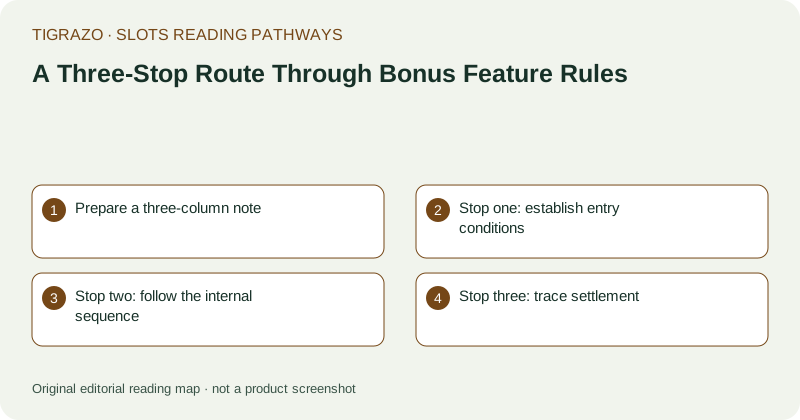
Prepare a three-column note
Before reading the feature description, draw columns labelled entry, activity and settlement. Put each rule into one column. This prevents a statement about getting into the feature from being mistaken for a statement about what it pays. Leave a question mark wherever the wording does not establish the relationship.
Use the exact rule version you are reading. Similar feature names can conceal different symbol requirements, starting counts and limits. Familiar vocabulary is a navigation aid, not proof that two features behave alike.
Stop one: establish entry conditions
Find the required symbols, their allowed positions and the relevant game state. A trigger might depend on a count anywhere on the grid, a particular reel arrangement or an additional eligibility setting. Determine whether the trigger itself pays an award separately from feature entry.
Checkpoint: explain a qualifying trigger and one near miss. If you cannot distinguish them without looking at the animation, the entry rule still needs attention. Also note whether any optional paid setting changes eligibility or round cost.
Stop two: follow the internal sequence
Read what happens after entry. Identify the starting number of actions, whether additional actions can be awarded, how multipliers develop and when special symbols reset. A feature with ten initial actions may have a different possible duration if retriggers are allowed.
Hypothetical example: a feature begins with eight free spins and awards four more after a specified retrigger. One retrigger produces twelve available spins in total. This arithmetic does not say that a retrigger will happen or that those spins will yield a positive award.
At this stop, distinguish a persistent feature state from independent round outcomes. A meter carrying forward does not automatically mean every next event has a better chance.
Stop three: trace settlement
Find when awards are added, whether the displayed amount is cumulative and whether any maximum applies. A running total may already include earlier wins. Adding it again to individual figures would double-count the same money.
Check how a maximum award affects the remaining sequence. Some rules may end play once a cap is reached; others may explain settlement differently. Do not infer the process from the phrase maximum win alone.
Exit checkpoint: retell one complete route
Explain a hypothetical path from trigger to final credit in five sentences. Include the entry condition, starting actions, a possible retrigger, award accumulation and settlement. Then identify which parts are conditional rather than guaranteed.
- Was an additional purchase involved?
- Is the trigger award separate?
- Does the displayed total already contain earlier amounts?
- Which rule limits the sequence?
If one stage remains unclear, revisit that column only. Focused rereading is usually more useful than restarting the entire description.